
Industry Insights & Botanical Science
Discover technical research, ingredient innovations, and global health market trends from ISN Biotech Co., Ltd.
Choosing the China Best Blueberry Extract Powder Supplier requires more than comparing prices or reading polished product pages. The real question is whether a supplier can deliver stable quality, clear documentation, and consistent batches. Blueberry Extract Powder may look uniform in a sample bag, yet its anthocyanin content can vary with fruit variety, harvest timing, drying temperature, and storage humidity.
Dr. Mary Ann Lila, a recognized plant-based nutrition researcher, has described plants as “complex chemical factories.” That reminder matters here. A reliable supplier should explain its raw material source, extraction method, standardization level, and testing procedures. Buyers should request a current certificate of analysis, including anthocyanins, moisture, microbial limits, heavy metals, and pesticide screening. Independent laboratory verification adds another layer of confidence.
Practical experience also reveals small details. A strong purple color is not proof of high quality. A clean berry aroma, fine texture, and sealed moisture-resistant packaging provide useful clues, but they cannot replace laboratory data. The best supplier should answer technical questions without vague promises. It should also provide traceability from fruit source to finished powder.
Perfection is unlikely. Even experienced manufacturers may face seasonal variation or supply delays. The important point is honest communication and controlled correction. This guide examines how to compare Chinese suppliers, evaluate product evidence, and identify a Blueberry Extract Powder partner suitable for stable, responsible, and transparent sourcing.
What Is Blueberry Extract Powder?
What Is Blueberry Extract Powder?
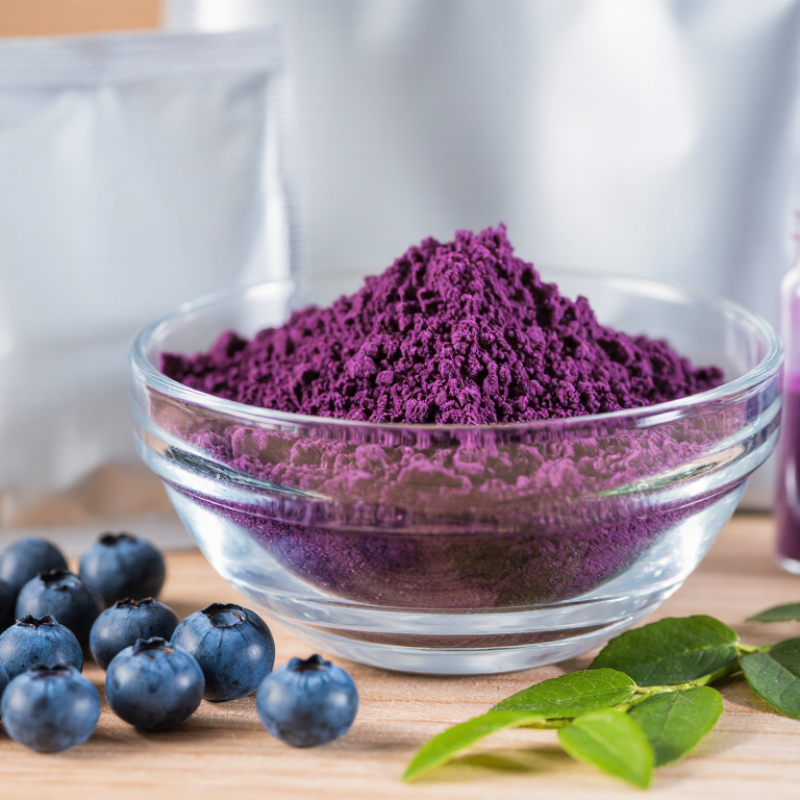
Blueberry extract powder is a concentrated ingredient made from ripe blueberry fruit. Manufacturers usually extract selected compounds, then remove moisture through spray drying or freeze-drying. The final powder contains anthocyanins, polyphenols, and natural fruit pigments. Its flavor may be mildly tart, earthy, or surprisingly weak. Processing conditions affect all three.
This powder is used in beverages, nutrition blends, yogurt, bakery products, and capsules. However, it is not simply ground dried blueberries. Extract strength can vary greatly between batches. A responsible buyer should check the botanical name, extraction ratio, anthocyanin content, moisture level, and microbial test results. A certificate of analysis also helps verify heavy metals, pesticides, and residual solvents. Color alone can mislead. A deep purple shade does not always prove higher quality. I would avoid making strong health claims without validated evidence and local regulatory review.
Tips: Select powder with clear specifications and traceable testing records. Ask whether carriers or added sugars are present. Compare solubility in cool water, because clumping may reveal poor processing. Store the powder in a sealed, light-resistant container. Humidity is an overlooked problem. A supplier may provide impressive numbers, yet weak documentation should still raise questions.
China Best Blueberry Extract Powder Supplier? - What Is Blueberry Extract Powder?
| Data Dimension | Typical Information | Description and Quality Considerations |
|---|---|---|
| Product Definition | Dehydrated blueberry fruit extract | A powdered ingredient produced by extracting compounds from blueberry fruit and removing water. It is commonly used in beverages, dietary supplements, foods, and cosmetic formulations. |
| Botanical Source | Vaccinium species | Commercial materials may be derived from highbush blueberry, lowbush blueberry, or related Vaccinium species. The exact species and plant part should be stated in the product specification. |
| Appearance | Purple-red to dark purple powder | Color depends on the berry variety, extraction process, concentration, drying method, and anthocyanin content. A uniform color and absence of foreign particles are desirable. |
| Characteristic Flavor | Mildly fruity, sweet-tart blueberry flavor | The flavor may become more concentrated or acidic after extraction. Off-odors, excessive bitterness, or burnt notes may indicate poor raw material or processing conditions. |
| Key Bioactive Compounds | Anthocyanins, flavonols, phenolic acids, and proanthocyanidins | Blueberries are recognized sources of polyphenols, especially anthocyanins. The concentration varies significantly according to cultivar, maturity, origin, extraction solvent, and drying process. |
| Anthocyanin Standardization | Commonly specified by percentage or by total anthocyanin content | A reliable specification should identify the analytical method, expression basis, and test result. Anthocyanins are sensitive to light, heat, oxygen, and unsuitable pH conditions. |
| Extraction Method | Water or food-grade hydroalcoholic extraction | The extraction method influences color, flavor, polyphenol profile, and residual solvent requirements. The process should comply with applicable food or dietary-supplement regulations. |
| Drying Method | Spray drying or freeze drying | Spray drying is generally more economical and can provide good powder flow. Freeze drying can better preserve heat-sensitive characteristics but is usually more costly. |
| Moisture Content | Typically not more than 5% to 8% | The exact limit depends on the formulation and drying process. Lower moisture generally improves storage stability, but packaging and water activity should also be evaluated. |
| Water Activity | Often targeted below 0.30 | Water activity is more informative than moisture alone for microbial and physical stability. The acceptance limit should be confirmed through the supplier’s certificate of analysis. |
| Solubility and Dispersibility | Water-dispersible; solubility varies by carrier and extract type | Some powders dissolve completely, while others form a colored dispersion because of fiber, fruit solids, or carrier materials. A sample test is recommended for beverage applications. |
| Typical pH of Aqueous Solution | Approximately pH 2.5–4.5 | Blueberry extracts are naturally acidic, but pH depends on concentration, extraction conditions, and added ingredients. Anthocyanin color can change with pH. |
| Particle Size | Commonly around 80–120 mesh | Particle-size specifications differ according to the intended use. Consistent particle size supports blending, dosing, and dispersion. |
| Carrier Ingredients | May include maltodextrin, gum acacia, or no carrier | Carriers can improve powder flow, reduce stickiness, and protect color. The full ingredient declaration is important when a clean-label, allergen-free, or carrier-free product is required. |
| Microbiological Quality | Must meet the applicable food or supplement limits | Testing commonly includes total aerobic count, yeast and mold, coliforms, and specified pathogens such as Salmonella and Escherichia coli, according to the destination market. |
| Contaminant Testing | Heavy metals, pesticides, and mycotoxins as applicable | A qualified supplier should provide recent test results or a certificate of analysis that demonstrates compliance with the legal requirements of the target market. |
| Storage Conditions | Cool, dry, dark, and tightly sealed | Protection from moisture, oxygen, heat, and light helps preserve color and anthocyanin content. Reseal the package promptly after opening. |
| Typical Shelf Life | Usually 24 months when unopened and properly stored | The actual shelf life must be supported by stability data and confirmed on the product label or specification sheet. |
| Supplier Evaluation Criteria | Traceability, testing, consistency, documentation, and regulatory compliance | When selecting a supplier, compare botanical identification, extraction and drying processes, standardization data, batch-to-batch consistency, certificates of analysis, allergen statements, packaging, and quality-system certifications. |
Note: Specifications for blueberry extract powder vary by raw material, extraction process, concentration, carrier, and intended application. Always verify the current product specification and batch-specific certificate of analysis before purchase or formulation.
FAQS
It is a concentrated powder made from ripe blueberry fruit. Moisture is removed by spray-drying or freeze-drying. It may contain anthocyanins, polyphenols, and natural fruit pigments. Processing changes its color, taste, and strength.
No. Extract powder concentrates selected compounds from the fruit. Dried blueberry powder usually contains more whole-fruit material. The two powders can differ in taste, solubility, and composition.
It can be added to beverages, nutrition blends, yogurt, bakery products, and capsules. Some formulas use very small amounts. Always check compatibility with the final product.
Review the botanical name, extraction ratio, anthocyanin content, moisture, and microbial results. Check heavy metals, pesticides, and residual solvents. A recent certificate of analysis is useful. Color alone proves little.
Compare the sample with its written specification. Observe the color, aroma, particle texture, and solubility. Stir a small amount into cool water. Clumping may suggest poor processing, though it is not conclusive.
Request a representative sample, recent certificate of analysis, batch records, and traceability documents. Check the lot number, production date, packaging seal, and shelf life. Testing should cover the exact shipment. General reports may be insufficient.
Ask how the supplier handles an out-of-specification batch. A clear answer should include investigation, records, and corrective action. Technical staff should understand assay methods and quality limits. Attractive brochures are not enough.
Keep it in a sealed, light-resistant container. Protect it from humidity and heat. Moisture is easy to overlook. I might underestimate this risk myself. Recheck the powder before use.
Conclusion
Blueberry Extract Powder is a concentrated botanical ingredient made from carefully selected blueberries. It typically contains naturally occurring anthocyanins, polyphenols, and other plant compounds, depending on the fruit variety and extraction method. In China, production generally involves sorting and washing fresh or dried blueberries, extracting the desired compounds with suitable food-grade processes, concentrating the liquid, and spray-drying or freeze-drying it into a stable powder. Proper control of temperature, moisture, and processing conditions helps preserve color, flavor, and nutritional value.
Reliable suppliers should provide consistent specifications, clear ingredient information, batch traceability, and testing for purity, microbial safety, heavy metals, pesticides, moisture, and active compounds. Buyers can evaluate suppliers by reviewing certifications, quality-control procedures, production capacity, documentation, samples, packaging, and communication. Blueberry Extract Powder is commonly used in beverages, dietary supplements, functional foods, cosmetics, and nutritional formulations. Its potential benefits include antioxidant support and convenient delivery of blueberry-derived plant compounds, although product performance depends on composition, dosage, and responsible use.